
2026 Waltons RTÉ lyric fm
Music for Schools Competition
A National Celebration
of Music in Irish Schools
This page includes:
- Entry videos and information about the twelve Finalist schools selected for the 2026 Competition.
- Lists of Commended, Highly Commended and Very Highly Commended schools.
- Information about the 2026 Finalists Concert Guest Adjudicators.
The page will soon include:
- Information about the 2026 Finalists Concert Interval Act.
- A list of the 2026 prize-winning schools.
- Videos of the Finalists Concert.
- Photos of the Finalists Concert.
Primary School Finalists
This section lists the six Primary Finalists, as well as Commended, Highly Commended and Very Highly Commended schools, selected in the 2025 Waltons RTÉ lyric fm Music for Schools Competition. All performers in commended school groups receive individual certificates acknowledging their achievement.
Schools are listed in alphabetical order, and the Primary Finalist entry videos, as well as how the groups addressed the 2026 Competition theme, Rhythm Rules!, are below these.
Finalists
- Bunscoil Loreto, Gorey, Co. Wexford
- Danescastle National School, Carrig on Bannow, Co. Wexford
- Newcastle National School, Athenry, Co. Galway
- St. Brigid’s National School, Tooreen, Co. Mayo
- St. Marnock’s National School, Portmarnock, Co. Dublin
- St. Teresa’s National School, Killoe, Co. Longford
Very Highly Commended
- Gaelscoil Iarfhlatha, Tuam, Co. Galway
- Gaelscoil Ó Doghair, Caisleán Nua Thiar, Co. Limerick
- Kilmeen National School, Clonakilty, Co. Cork
- Scoil Bernadette, Montenotte, Co. Cork
- Scoil Mhuire agus Naomh Treasa, Killarney, Co. Kerry
- Ss. Peter and Paul’s CBS, Clonmel, Co. Tipperary
- St. Ciaran’s National School, Athlone, Co. Westmeath
Highly Commended
- Castletown Primary School, Castletown, Co. Laois
- Scoil Chlann Naofa, Ballinamore, Co. Leitrim
- Scoil Iosef Naofa, Roscrea, Co. Tipperary
- St. Tola’s National School, Shannon, Co. Clare
- Woodbrook National School, Carrick-on-Shannon, Co. Roscommon
Commended
- Glinsk National School, Glinsk, Co. Galway
- Maryborough National School, Portlaoise, Co. Laois
- Our Lady’s National School, Milltown, Dublin 14
- St. Christopher’s Primary School, Dublin 4
- St. Olaf’s National School, Dundrum, Dublin 16
Bunscoil Loreto
Gorey, Co. Wexford
Entry
Title ‘The Rhythm of Life’
Group Bunscoil Loreto Ensemble • Junior Infants – Sixth Class
Addressing the Theme
When senior music and ballad group members discussed how they would address the theme, they decided that since Bunscoil Loreto is a School of Sanctuary and a number of children in school had to leave their home countries as a result of war, they would do so through the story of sanctuary. They chose Michael Jackson’s ‘They Don’t Really Care About Us’ as the start of their entry to show the two sides of war, amending the lyrics and putting the youngest children in the middle to show how children too often get caught in the crossfire. They then decided to get these children to shout ‘stop!’ to end the fighting, with one of them then singing the start of John Lennon’s ‘Give Peace a Chance’ and the rest of the group joining in. Two 6th class girls wrote a rap to go with the song:
Everybody’s talking ’bout revolution, evolution
Mass inflation, regulation, integration, segregation
Meditation, United Nations,
Congratulations
All we are saying
Is give peace a chance
All we are saying
Is give peace a chance
Everybody’s talking ’bout Palestine, Israel,
Ukraine, Russia, Afghanistan, Algeria,
Somalia, Uganda, weapons, war,
What is it all for?
They then decided to finish their piece with the Amble song ‘Tonnta’, with its theme of belonging:
We don’t belong to the same boat
It’s the storm we share
We all belong to the one road
It’s up to you get there
The students made their own shakers for the piece, and they were delighted to accidentally find a drummer to join the group. One of the boys loved to bring his pencils on his movement breaks and would use them as drumsticks when he was passing the drum kit in the school gym. He asked to play drums and was given proper drumsticks to try it. He started drum lessons a week before their video was shot.
Bunscoil Loreto has participated in Music for Schools since 2013. The school was a Finalist in 2014, 2016, 2019 and 2020, won Third Prize in 2015 and 2017 and was Very Highly Commended in 2025.
Danescastle National School
Carrig on Bannow, Co. Wexford
Entry
Title ‘Rocking Rhythm’
Group Caisleán an Danairm • First – Sixth Class
Addressing the Theme
The group discussed this year’s theme, exploring the meaning of the words ‘Rhythm Rules’ and how rhythm can communicate ideas. One of the younger students said that they automatically think of School Rules when hearing the word ‘rules’, and the group agreed that school rules could be made more engaging by setting them to a rhythm. Together with the school’s principal, they created lyrics and chose Queen’s ‘We Will Rock You’ as their rhythmic foundation, using its strong beat and body percussion to bring their words to life. As the school has a strong tradition of Irish music and the recording took place during Seachtain na Gaeilge, it was important to include an Irish element, so ‘Óró sé do Bheatha Abhaile’ was woven throughout the performance. And to further celebrate traditional music, they decided to learn a new polka, ‘Ryan’s Polka’. The students also suggested incorporating lilting and whistling, recognising these as important traditional practices that they are proud to continue.
Danescastle National School has participated in Music for Schools since 2012. The school was a Finalist in 2015 and was Very Highly Commended in 2025.
Newcastle National School
Athenry, Co. Galway
Entry
Title ‘A Chuisle Mo Chroí’
Group Newcastle Athenry Glee and Music Club • First – Sixth Class
Grainne O’Neill • Guitar
Addressing the Theme
After watching performances from previous years, the school’s Glee and Music Club were so inspired by the creativity and quality of other schools’ compositions that they decided to create their own. Initially, they brought up as many songs as we could that included the word ‘rhythm’ and listened to them together. Since none of them were quite right, they decided to create their own song. Armed with post-it notes and paper, everyone jotted down their thoughts and feelings about rhythm until they had a huge collection of possible lyrics. A group of girls then approached the teacher with an almost fully formed song, with a first verse and melody included. From there, they worked out some guitar chords, and the girls taught their verse to the rest of the group. The group then built a second verse using the ideas they had come up with. Once the structure was in place, instrumentalists were brought in, and with a little help from the teachers, the chorus melody was transposed for the different instruments and given a traditional Irish flair. For the finale, they took inspiration from their Christmas performance of ‘Kingfishr’s ‘Killeigh’. The students loved singing the ‘fa la la la la’ section and were determined to include something similar in our own piece. Regarding the title, the students wanted something meaningful that reflected the theme but also included our native language. The phrase ‘rhythm of the heart’ resonated with everyone, and they loved the idea that music is the rhythm of life. So ‘A Chuisle Mo Chroí’ (Beat of My Heart, a term of affection) became the title and theme of their piece.
Newcastle National School has participated in Music for Schools before and was Highly Commended in 2024.
St. Brigid’s National School
Tooreen, Co. Mayo
Entry
Title ‘The Tooreen Rhythms’
Group St. Brigid’s Music Group • Third – Sixth Class
• Edel Fleming, Conductor • Stephen Doherty, Piano & Bodhrán
Addressing the Theme
Students in the school’s music group, which meets every Wednesday after school, brainstormed the theme and then voted for the song – ‘Sapphire’ by Ed Sheeran – that they felt best embodied it. It was chosen not only for its strong rhythm and pulse but also because they felt that they could put a traditional twist to it. The group also considered how they could include rhythms and actions into their performance that would represent the school. They included their love of the Irish language, two hurls to show the love of hurling in Tooreen, rhythmic lilting, and the rhythms of Irish and sean-nós dancing. The students also wanted to include ‘The Old Concertina Reel’ into the performance to showcase their interest in traditional Irish music. The entire piece was collaboratively arranged, with the students playing and singing different lines, playing harmony on their instruments, creating body percussion rhythms and incorporating off-beat syncopated rhythms throughout the piece. Finally, the students together wrote a new chorus:
Don’t you know the rhythm rules in this beat,
We groove to the sound of our school’s music,
We clap and stomp to the syncopated beat,
Sing, sing, sing — let the rhythm rule.
Can you hear the rhythm flow through this beat?
The tempo and tone is quick and sweet,
We’ll be clicking our fingers and creating music,
Bígí ag canadh leis na rialacha rithime!
St. Brigid’s National School has participated in Music for Schools before and was Very Highly Commended in 2025.
St. Marnock’s National School
Portmarnock, Co. Dublin
Entry
Title ‘Rhythm Rulz’
Group Marnock’s Music Group • First – Sixth Class
• Mary Kenealy, Conductor
Addressing the Theme
St. Marnock’s began work on their entry with small groups of students brainstorming ideas around the theme. These coalesced into two:
- Rhythm rules that we follow
- Leaving these rules aside to make our own rules when making music
They also looked to nature and the influence of the school’s seaside location. The sea provides its own ‘pulse’ through the natural rhythms of waves and tides. The group then chose songs that represented their ideas of rules that we follow and rules that we break free from. They looked at the work of graffiti artists who break the rules of traditional painting and represented with their painted graffiti slogan, ‘Rhythm Rulz’. They also decided that the sea would be visually represented by moving silks and two boats on either side. Finally, the teachers encouraged improvisation in the group, and their early sessions included ‘jamming’ and exploring material suggested by the performers. Their original music, used to link the whole piece together, is structured around the two contrasting themes. It began with a chord progression suggested by two of the students, with brainstormed lyrics and a melody developed in their jam sessions. Echoes, harmonies and accompaniment were also developed over the weeks. They then decided on existing songs that both represented their themes and worked with their original material. ‘I Want to Break Free’ by Queen was suggested by the group’s guitarist and vocalist. They then chose the traditional song ‘Dúlamán’ for its strong rhythm, because it contrasted so well with the previous song and because it was so appropriate for a school by the sea. (Dúlamán is a type of seaweed in Irish.) After ‘Dúlamán’, strong drumbeats introduce the song ‘Believer’ by Imagine Dragons. The song was a particular favourite with the group and lyrically supported the journey of the piece: ‘Don’t you tell me what I can be. I’m the one at the sail, I’m the master of my sea’. The piece concludes with a return to their original themes.
St. Marnock’s National School has participated in Music for Schools before and won Second Prize in 2025.
St. Teresa’s National School
Killoe, Co. Longford
Entry
Title ‘Feeling the Rhythm’
Group St. Teresa’s Ensemble • First – Sixth Class
• Grainne Fox, Conductor
Addressing the Theme
St. Teresa’s began the process with a meeting to explore and discuss what the theme meant to them and how they could express it in their entry. They then split into smaller groups, with a student from 6th class leading each group, and returned with their ideas of what rhythm meant to them. There were a number of similarities – including mentions of beat, pulse and movement, as well how rhythm could be expressed with clapping, stamping, rhyming, clicking, shaking and tapping instruments. There were many different song ideas. One group suggested using the rhythm and melody of the song ‘We Will Rock You’ by Queen and writing original lyrics. So a smaller group of 4th – 6th Class students got together to write the lyrics at a later stage of the process. Some of the 6th Class students were familiar with ‘The Rhythm of Life’, and this song was added as well. The singers began by learning the melody line of the chorus, which evolved into learning four different parts, all with different rhythms and melodies. The original version of the song had key changes that didn’t suit their guitar players, so they changed things a bit so that they could stay in the same key for the chorus and stay on an E minor chord for the transition from their first song. A favourite idea came from Mya, one of the 6th class students, who mentioned that although both of her parents are deaf and can’t hear the sound of a song, they can experience its rhythm through vibration and movement. Inspired by this, they decided to call their entry ‘Feeling the Rhythm’. Mya taught the group how to sign the chorus of the original lyrics using Irish Sign Language, so every student signs the lines ‘Sing it, Move it, Play it. Rhythm Rules, Let’s say it!’ The performance begins with just the rhythm created by stamping and clapping and with Mya and her two friends signing the chorus before any music or singing come in. This is a representation of how rhythm can be felt in many ways. The Irish dancers in the group came up with their own rhythm to suit the melody of ‘We Will Rock You’, while the other students played tin whistle, glockenspiel, guitar, piano and percussion to accompany them. All students were actively involved throughout the entire process – composing lyrics, developing choreography, creating rhythms, singing in parts and playing instruments. The older children mentored the younger ones, ensuring that every voice was heard and included. The final piece celebrates rhythm not just as a pattern of sound, but as something everyone can experience and share together.
St. Teresa’s National School has participated in Music for Schools before and won Second Prize in 2024.
Post-Primary School Finalists
This section lists the six Post-Primary Finalists, as well as Commended, Highly Commended and Very Highly Commended schools, selected in the 2026 Waltons RTÉ lyric fm Music for Schools Competition. All performers in commended school groups receive individual certificates acknowledging their achievement.
Schools are listed in alphabetical order, and the Post-Primary Finalist entry videos, as well as how the groups addressed the 2025 Competition theme, The Key of Life, are below these.
Finalists
- Coláiste De Lacy, Ashbourne, Co. Meath
- De La Salle College, Dundalk, Co. Louth
- East Glendalough School, Wicklow, Co. Wicklow
- Mountrath Community School, Mountrath, Co. Laois
- Skibbereen Community School, Skibbereen, Co. Cork
- St. Mary’s Secondary School, Macroom, Co. Cork
Very Highly Commended
- Ardscoil na Mara, Tramore, Co. Waterford
- Coláiste Eoin, Hacketstown, Co. Carlow
- Ennistymon Community School, Ennistymon, Co. Clare
- Sancta Maria College, Louisburgh, Co. Mayo
- St. Fergal’s College, Rathdowney, Co. Laois
- Ursuline College, Sligo, Co. Sligo
Highly Commended
- Ard Scoil Chiaran Naofa, Clara, Co. Offaly
- Assumption Secondary School, Walkinstown, Dublin 12
- Coláiste Éanna – Entry 8, Rathfarnham, Dublin 16
- Le Chéile Secondary School, Ballincollig, Co. Cork
- Rice College, Ennis, Co. Clare
- St. Kilian’s Community School, Bray, Co. Wicklow
Commended
- Coláiste Éanna – Entries 1-7, Rathfarnham, Dublin 16
- St. Clare’s Comprehensive School, Manorhamilton, Co. Leitrim
Coláiste De Lacy
Ashbourne, Co. Meath
Entry
Title ‘Rhythm Everywhere’
Group Coláiste De Lacy Ensemble • Second – Sixth Year
Addressing the Theme
The development of Coláiste De Lacy’s entry was inclusive, collaborative, student centred and reflective of the diverse makeup of their multicultural school community. (Roughly 20% of the population of Ashbourne were born in another country.) The students selected the song ‘Pompeii’ by Bastille because of its rich rhythmic qualities, challenging vocal parts and a message that resonated deeply with them. It tells the story of someone facing a difficult moment yet holding onto hope for the future. They also chose ‘Viva La Vida’ by Coldplay for its message that brighter times will come – Dá fhada an lá, tagann an tráthnóna – as well as for its uplifting, rhythmic energy. To support both leadership and ownership, they appointed a senior‑cycle music ‘captain’ for each section of the group: vocal, percussion, strings and brass, Irish traditional, keyboard and guitars. These captains organised rehearsals at lunchtime and after school, arranged parts to suit the strengths of their members and helped to guide the younger musicians. The rhythmic aspect of the entry was developed entirely by ear, experimenting with djembe, drum kit, body percussion and polyrhythms until they found patterns that they found both exciting and authentic. The vocal aspect was developed with the guidance of vocalist captains, who created arrangements tailored to the group’s abilities that also allowed the singers to explore multiple textures and two-, three- and four-part harmonies.
This is the first year that Coláiste De Lacy has participated in Music for Schools.
De La Salle College
Dundalk, Co. Louth
Entry
Title ‘A Symphony of Rhythm and Blues!’
Group Le Chéile • First – Fifth Year
• Pamela Campbell, Conductor
Addressing the Theme
Following a whole school announcement on the intercom, all interested students – from First to Sixth Year – met in the music room and started planning. De La Salle is fortunate to have a diverse ethnic and cultural mix, which is on display in their performance. Irish traditional and African music in particular are alive and well in their music room and school. In both traditions, rhythm isn’t just a background element in a composition; it’s one of the forces that gives the music its identity and emotional power. Humans are almost wired to react to rhythm. A steady pulse can make people sway, tap their feet or even feel tension when the beat shifts. That physical connection, one of the most primal ways that music communicates, is something that they wanted to communicate through their entry, which includes ‘Blackbird’ by Paul McCartney, ‘Hillsbrook Reels’ by Michael McGoldrick and ‘Isn’t She Lovely’ by Stevie Wonder.
De La Salle College has participated in Music for Schools before and was Very Highly Commended in 2024.
East Glendalough School
Wicklow, Co. Wicklow
Entry
Title ‘Rhythmic Resonance’
Group SEast Glendalough Ensemble • First – Sixth Year
Addressing the Theme
East Glendalough’s entry was developed through a collaborative and student-led process, which included students in all music classes in the school rather than just the students involved in this competition. Using a Google Form, students shared what the theme meant to them, as well as suggesting songs and arrangement ideas. A strong preference emerged for the presence of Irish music in the entry, as many students felt that Irish and folk traditions are deeply rooted in rhythm. Students chose ‘Man on the Moon’ because they loved this Kingfishr song about the struggles of pursuing your passions – but when analysing it, they discovered its particular relevance to the theme. While the melody is quite simple (for example, verse 1 is within a major third), it is the rhythm that makes the song so engaging and memorable. ‘The Caucus Reel’ was included to highlight the importance of rhythm in Irish music – further enhanced through an Irish dancer who choreographed her own routine to emphasise and interact with the rhythm. The students were also drawn to ‘Sweet Dreams’ by the Eurythmics, with its strong, repetitive bass line and rhythmic drive. They agreed that this was a song that they couldn’t help but move or clap along to, but they decided to adapt the lyrics to better reflect the theme. The song begins with body percussion, which the students felt is a universal and instinctive response to rhythm, and the song’s new lyrics focus on how rhythm moves and connects people: ‘Some of it wants to move you, some of it wants you to be moved, some of it wants to drive you, some of it is what brings music to you’. Inclusiveness was also a key focus, and the group not only includes all school years but also a wide range of abilities – in particular students with ASD and ADHD, who feel a real sense of belonging and whose confidence has grown significantly through their participation in the competition. The group also provided a space for some talented performers with other additional needs to shine. Students took on leadership roles throughout the process, with senior students mentoring younger ones. Many junior students were inspired to expand their repertoire and technique, and this extended beyond the competition – for example, 2nd Years learning songs from 5th and 6th Years and then performing them by themselves. Overall, the students developed connections and friendships with students in other years who they would not usually cross paths with, and they all were very supportive of one another, often taking the initiative to work together outside of rehearsal time.
East Glendalough School has participated in Music for Schools before. The school was a Finalist in 2024 and was Very Highly Commended in 2025.
Mountrath Community School
Mountrath, Co. Laois
Entry
Title ‘Rhythm Rules’
Group MCS Trad Group • First – Fifth Year
Addressing the Theme
Mountrath’s entry – which begins with ‘Frenzie’s Polka’, moving on to the song ‘Dúlaman’ and finishing with ‘Frankie’s Reel’ – was developed entirely by the students, from the initial brainstorm to the final arrangement and performance. This year’s theme, Rhythm Rules, immediately resonated with the group. As a traditional Irish ensemble, they recognised how deeply rhythm underpins the genre and were eager to showcase the driving, vibrant rhythmic identity of Irish music in a fresh and contemporary way. To do this, they decided on fast-paced tunes and an upbeat, catchy song. According to their teacher, whose role was simply to facilitate rehearsals and guide them through the performance process, the group demonstrated remarkable musical ability, creativity and maturity. They collaborated closely to arrange the piece, experimenting with style, structure and instrumentation. And they blended strong traditional elements with a contemporary edge – for example, incorporating guitar and a rock-influenced bodhrán pulse – to create a modern interpretation that remains grounded in the essence of Irish music.
This is the first year that Mountrath Community School has participated in Music for Schools.
Skibbereen Community School
Skibbereen, Co. Cork
Entry
Title ‘Sultans of Rhythm’
Group SSCS Music Ensemble • First – Sixth Year
• Colette Brennan, Conductor
Addressing the Theme
Skibbereen’s entry – which blends rock, Irish traditional and soul – was created with a steady ‘beat’ as a common thread across different eras and genres. 5th-Year music students were the primary creative drivers. Many of them enjoy playing the great rock songs of the 1970s, so they decided to begin their entry with the iconic guitar-driven groove of Dire Straits’ ‘Sultans of Swing’. And since the school has a number of fine trad musicians, they decided to continue ít with the driving rhythm of ‘The Glasgow Reel’. To complete the piece, they chose ‘Beggin’ by The Four Seasons (with a modern version by Måneskin) not only for its punchy soul sound but also because it could be adapted to lock into the steady beat of the other two elements. The 5th Years also led the rehearsal process, refined the transitions between songs and collaborated on the dynamic shifts to ensure the medley felt like a single, cohesive story rather than three separate parts.
Skibbereen Community School has participated in Music for Schools before and was Very Highly Commended in 2025.
St. Mary’s Secondary School
Macroom, Co. Cork
Entry
Title ‘The Rhythm of Change’
Group St. Mary’s Ensemble • First – Fifth Year
Addressing the Theme
St. Mary’s creative process began with a collaborative deep dive into the concept of rhythm as a social force – a tool for change rather just a musical element. One student noted that protests around the world are built on the foundation of chanting and collective pulse – rhythm as the heartbeat of a movement. This fuelled the group’s desire to address the current global climate of uncertainty through their performance. They decided to open with the iconic riff of the White Stripes’ ‘Seven Nation Army’, chosen for its raw energy. By building layers around the riff, they wanted to create a minor, unsettled tonality to mirror the uncertainty in the world today. Students composed the body percussion themselves, intending it to represent the power of rhythm in protest as they march to the same beat and stand up against war and injustice. The group’s second piece, Tracy Chapman’s ‘Talkin’ Bout a Revolution’, was chosen for its strong rhythm and chant-like feel, as well as for its message of change – with a hint of hope. The trad musicians in the group composed a 4/4 melody to sit beneath the song, intended as a metaphor for how different genres, like different ethnicities and beliefs, can coexist and connect. An a cappella section provided a moment of stillness, signalling a shift towards change. And they used this as a transition to Marvin Gay’s ‘Dancing in the Streets’, representing a future without war and conflict. They also decided to reintroduce the opening riff, but with altered tonality, at this point, as a reminder that what we fear is never too far away. Finally, they represented their theme visually with red costumes to represent the energy, power and passion required for change and blue and white ribbons worn by vocalists and placed on stands to symbolise the peace and calm we collectively strive for. Throughout the process, the students were committed to producing an entry they could all be proud of. One musician even learned the rudiments of drum kit in just one week to fulfil the group’s vision for the final song.
St. Mary’s Secondary School has participated in Music for Schools before. The school was a Finalist in 2024 and was Very Highly Commended in 2025.
Finalists Concert
After the Waltons RTÉ lyric fm Music for Schools Competition 2026 Finalists Concert in the National Concert Hall on 18 May 2026, this section will include videos, in concert order, of the twelve Finalist groups performing.
Finalists Concert Adjudicators
Aedín Gormley
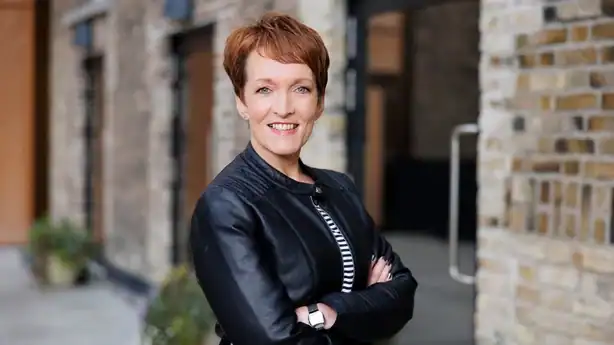 Aedín has been working in radio for most of her life. She has a huge love of music and studied piano and theory at the College of Music in Dublin (now the TU Dublin Conservatoire). She first worked in Irish language broadcasting and then at RTÉ Radio 1, initially as a member of the Presentation Department and then as presenter of The Weekend on One. Aedín joined RTÉ lyric fm when the station was founded in 1999, and Movies and Musicals, her hugely popular show, has been there from the start. The show features a broad range of soundtracks from early classics, as well as contemporary scores. Aedín has interviewed a number of renowned actors and performers for it, including Julie Andrews, Angela Lansbury, Mark Hamill, Colin Farrell, Colin Firth, Lin-Manuechatted with John Barry, Lalo Schifrin, Hans Zimmer, Alan Menken, Michael Giacchino, Marc Shaiman and Scott Wittman. During her til Miranda, Emily Blunt, Renée Zellweger, Elaine Stritch, Paul Mescal and Jessie Buckley. She also loves talking to composers, and over the years she has me on RTE lyric fm, she has also presented the award-winning arts programmes Artszone, My Tunes and Sunday Matinée. And she now presents Aedín in the Afternoon on Fridays, featuring an eclectic range of music and entertainment news. Aedín also loves collaborating with the RTÉ Concert Orchestra, most recently, presenting two sold out Movies and Musicals Live concerts at the Bord Gáis Energy Theatre.
Paul Noonan
 Paul is a songwriter, multi-instrumentalist and vocalist whose career has spanned more than three decades. Best known as the frontman of the celebrated Irish band Bell X1, Paul’s musical evolution reflects his restless creativity, collaborative spirit and continual reinvention across genres and projects. Raised in Lucan, he developed an early love of music through his father’s extensive vinyl record collection, and he began writing songs as a teenager, inspired by such acts as Hothouse Flowers and U2. At Salesian College, he met Damien Rice, Dominic Phillips and Brian Crosby, forming an early group that evolved into the band Juniper in 1991. After Rice’s departure, the remaining members became Bell X1, with Paul as lead singer and songwriter. With his charismatic presence and lyrical sensitivity at the helm, Bell X1 explored everything from vibrant indie rock to tender, introspective balladry. Albums such as Neither Am I, Music in Mouth, Flock, and Arms helped define the band’s rich, experimental catalogue. Although his core work remained with Bell X1, Paul has long embraced collaboration and exploration outside the band. He has contributed percussion, vocals and songwriting to projects by Gemma Hayes, the Frames and others, and in 2006 he appeared on the popular charity album The Cake Sale. In 2011, he launched his first major solo endeavour, Printer Clips, a project built around duets with a range of acclaimed singers. Released in 2014, the Printer Clips album featured collaborations with artists such as Joan as Policewoman, Martha Wainwright and Lisa Hannigan, showcasing Paul’s versatility and his ability to create intimate, emotionally resonant music outside Bell X1’s framework. His creative curiosity has also led him to work in music therapy, where he applies his craft in deeply human contexts – supporting older adults living with dementia, people with disorders of consciousness and children in areas of social disadvantage. He has also curated large-scale cultural projects, including Starboard Home and Imagining Ireland, presenting new and original Irish music with collaborators reflecting Ireland’s diverse creative landscape. In 2025, Paul returned to collaborate with his old friend Brian Crosby under a new name – Pilgrims. This project presents a reflective, intimate musical world anchored in piano, voice and atmospheric songcraft.
Interval Act
After the Waltons RTÉ lyric fm Music for Schools Competition 2026 Finalists Concert in the National Concert Hall on 18 May 2026, this section will include information about the interval act, the Discovery Gospel Choír, as well as a video of their performance.
Prize Winners
After the Waltons RTÉ lyric fm Music for Schools Competition 2026 Finalists Concert in the National Concert Hall on 18 May 2026, this section will include a list óf this year’s prize winners.
This section will include a selection of photographs of the six primary school music groups, in alphabetical order, rehearsing for their performances in the 2026 Finalists Concert.
This section will include a selection of photographs of the six post-primary school music groups, in alphabetical order, rehearsing for their performances in the 2026 Finalists Concert.
This section will include performance photos, in concert order, of the twelve school music groups performing in the 2026 Finalists Concert, as well as photos of prize presentations for the six winning schools.